"All models are wrong but some are useful." (George E. P. Box)
In my view, economics is a social science. Therefore, I strive for combining academic rigor with relevance for economic policy in my research. I strongly believe in economic and econometric modeling to generate useful insights into current economic issues while making explicit its underlying assumptions. The key question for any economic analysis is not whether the used model is an exact description of reality - it will never be - but whether it allows us to shed light onto pressing economic issues for today's policy makers and society at large.
Below, you can find some of my writing on the Transatlantic Trade and Investment Partnership (TTIP) as an example.
Below, you can find some of my writing on the Transatlantic Trade and Investment Partnership (TTIP) as an example.
The Potential Welfare Effects of the Transatlantic Trade and Investment Partnership (TTIP)
The currently negotiated TTIP is hotly debated in both academic research as well as the public policy arena. Together with my coauthors from the ifo Institute in Munich and the University of Bayreuth, I have analyzed the income, employment and welfare effects of a potential TTIP in a series of studies.
Particularly, I have worked on a study for the Bertelsmann Foundation which looks into the employment effects of TTIP using the methodology explained in one of my working papers with Mario Larch. For the Bertelsmann study, click here. For the underlying methodology working paper, click here. Jointly with my co-authors, I have published a study in Economic Policy which investigates in depth the robustness of our results. You can read a non-technical abridged version of the Economic Policy paper here. For the (gated) full paper in Economic Policy, please click here.
I have also co-authored a study commissioned by the Austrian Ministry of Economics, Family and Youth on the effects of TTIP and other currently negotiated mega-regionals with a specific focus on Austria.
Our series of studies has caused a lively debate and has been discussed in both national and international media outlets like the Financial Times, Frankfurter Allgemeine Zeitung, tageszeitung, Deutschlandfunk, Süddeutsche Zeitung, El Vigia (Spain) and more.
Leaving the technical details aside, the bottom line of this series of studies is that TTIP can create positive welfare gains in the signatory countries, but may also have negative consequences for excluded countries, especially developing and emerging economies. The gains/losses in per capita welfare (measured as percentage changes in real wages per capita) are depicted in the map below.
Particularly, I have worked on a study for the Bertelsmann Foundation which looks into the employment effects of TTIP using the methodology explained in one of my working papers with Mario Larch. For the Bertelsmann study, click here. For the underlying methodology working paper, click here. Jointly with my co-authors, I have published a study in Economic Policy which investigates in depth the robustness of our results. You can read a non-technical abridged version of the Economic Policy paper here. For the (gated) full paper in Economic Policy, please click here.
I have also co-authored a study commissioned by the Austrian Ministry of Economics, Family and Youth on the effects of TTIP and other currently negotiated mega-regionals with a specific focus on Austria.
Our series of studies has caused a lively debate and has been discussed in both national and international media outlets like the Financial Times, Frankfurter Allgemeine Zeitung, tageszeitung, Deutschlandfunk, Süddeutsche Zeitung, El Vigia (Spain) and more.
Leaving the technical details aside, the bottom line of this series of studies is that TTIP can create positive welfare gains in the signatory countries, but may also have negative consequences for excluded countries, especially developing and emerging economies. The gains/losses in per capita welfare (measured as percentage changes in real wages per capita) are depicted in the map below.
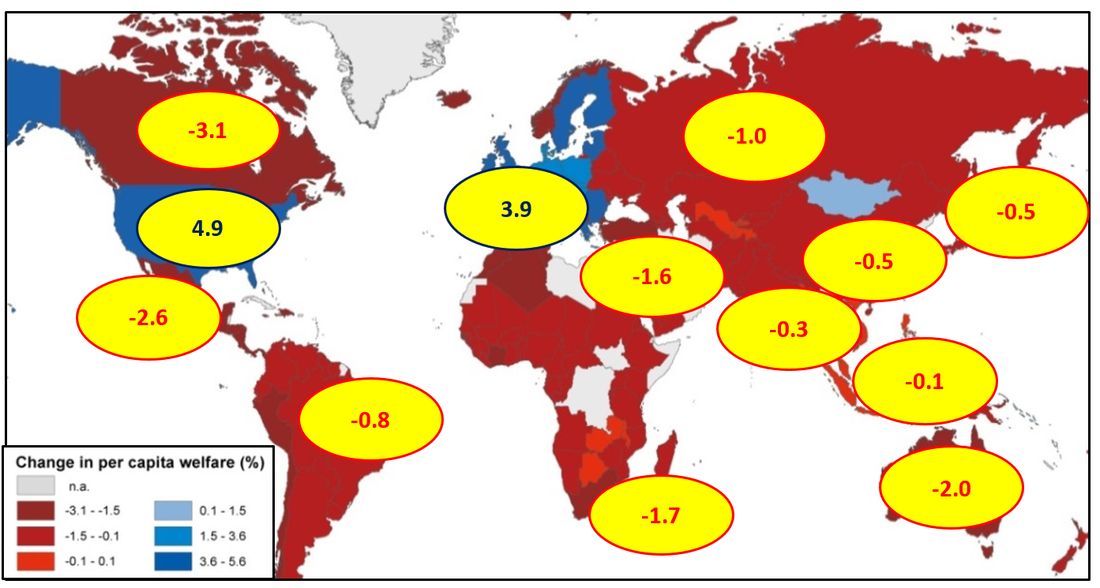
This graph depicts the counterfactual percentage changes in welfare (expressed as real wages per capita) of TTIP. The numbers are the baseline scenario model simulations from Felbermayr, Larch, Heid, Yalcin (2015), "Macroeconomic potentials of transatlantic free trade: A high resolution perspective for Europe and the world", Economic Policy, 83(3), pp. 491-537.
For my talk at the Economic Policy Forum Roundtable in Cape Town in November 2014, I used the same model to analyze the impact of other potential regional megadeals and trade agreements like the Transpacific Partnership (TPP), the Regional Comprehensive Economic Partnership Agreement (RCEP) as well as the African Free Trade Zone (AFTZ, not covered in the Economic Policy piece), with a specific focus on South Africa, in more detail. You can find my presentation slides here.
